

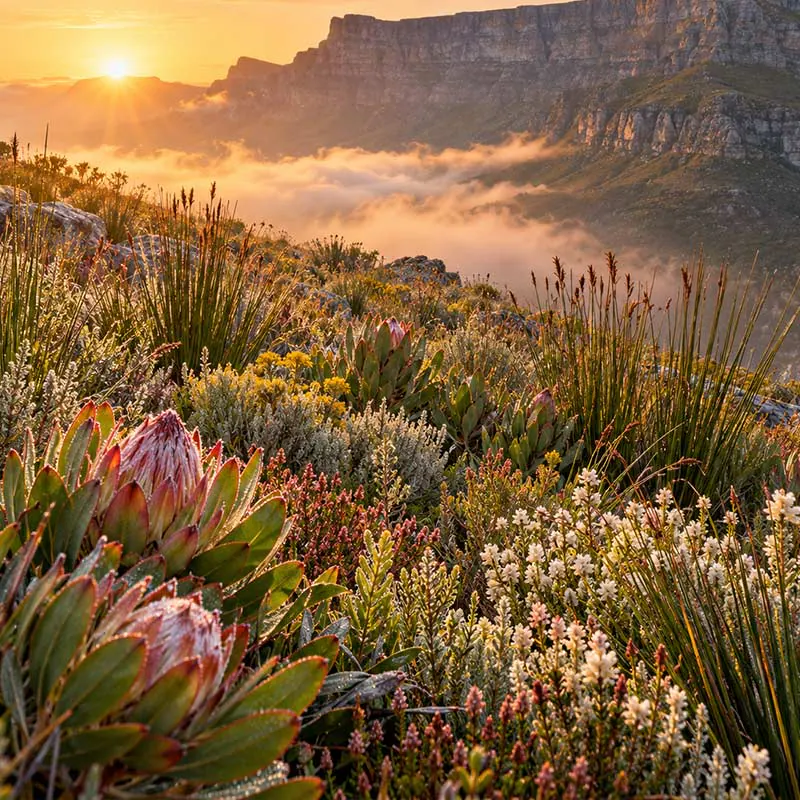
The Beauty of Fynbos on Lion’s Head and Table Mountain In The Western Cape
Cape Town is celebrated around the world for its dramatic mountains, beautiful coastline and extraordinary natural setting. Yet some of its greatest treasures are found much closer to the ground.
Across the slopes of Lion’s Head and Table Mountain grows an intricate tapestry of indigenous fynbos. Its fine leaves, unusual flowers and ever-changing colours bring texture and life to the landscape throughout the year.
From a distance, the mountains may appear rugged and windswept. Viewed more closely, their slopes reveal an exceptionally detailed natural garden shaped by the Cape’s climate, soils, wind and seasonal rainfall.
A Landscape Found Nowhere Else
Fynbos is one of the defining features of the Western Cape landscape.
Rather than referring to a single plant, the term describes a remarkably diverse type of vegetation containing many different shrubs, flowering plants, grasses and bulbs. Proteas, ericas and restios are among its best-known plant groups, but they represent only part of a much larger natural community.
Many fynbos plants have adapted to challenging local conditions. They grow in nutrient-poor soils, withstand strong winds and cope with long, dry summers.
What may initially look like low, simple vegetation is actually a complex ecosystem containing an extraordinary variety of shapes, colours and textures.
Fynbos on the Slopes of Lion’s Head
Lion’s Head rises above the city between Table Mountain and the Atlantic coastline. Its slopes provide sweeping views, popular walking routes and close encounters with indigenous vegetation.
As visitors follow the path around the mountain, the scenery continually changes. The city, ocean and surrounding peaks appear from different angles, while fynbos lines the route with seasonal flowers and delicate foliage.
The vegetation adds softness to the rocky slopes. Fine restios move in the wind, low shrubs cling to the ground and colourful flowers appear between stones and along the path.
Some plants are immediately noticeable, while others reward those who slow down and look more carefully. A tiny flower or unusual leaf can be just as captivating as the panoramic views for which Lion’s Head is famous.
The Living Slopes of Table Mountain
Table Mountain may be recognised for its imposing cliffs and distinctive flat summit, but its plant life is equally remarkable.
Its slopes contain a constantly changing mixture of vegetation shaped by elevation, sunlight, moisture and exposure. One area may be dense and green, while another is open, rocky and covered with low-growing plants.
After the winter rains, fresh growth brings renewed colour to the mountain. During warmer months, hardy plants continue to withstand the sun and wind, demonstrating the resilience for which fynbos is known.
Cloud and mist also transform the landscape. When the mountain is wrapped in its familiar tablecloth, droplets settle on leaves and flowers, creating a quieter and more mysterious atmosphere.
Beauty in the Smallest Details
The beauty of fynbos does not depend on size.
Some plants produce bold flowers that stand prominently above the surrounding vegetation. Others create tiny blossoms that are easily missed by anyone moving too quickly.
Look closely and the landscape reveals an impressive variety of details:
- Delicate flowers in pink, white, yellow, red and purple
- Fine leaves designed to limit moisture loss
- Textured seed heads and sculptural branches
- Soft grasses and restios moving in the breeze
- Silver, grey and deep-green foliage
- Insects and birds moving between flowering plants
Together, these individual details create a landscape that is always changing but still unmistakably Cape.
A Source of Inspiration for Local Makers
Fynbos has long inspired artists, designers, photographers and craftspeople.
Its colours and natural forms can be seen in South African paintings, textiles, ceramics, jewellery and homeware. Protea flowers provide bold sculptural inspiration, while finer plants offer delicate patterns, lines and textures.
For local makers, the surrounding landscape is more than a beautiful backdrop. It is a source of ideas and a reminder that good design can be distinctive without being excessive.
Craigz celebrates this connection between local creativity and the natural character of the Western Cape. Products inspired by the Cape landscape carry a sense of place and offer an opportunity to bring part of that story into the home.
Experiencing Fynbos Responsibly
The fynbos around Lion’s Head and Table Mountain is beautiful, but it is also sensitive.
Visitors can help protect the landscape by remaining on recognised paths, taking litter home and avoiding the removal of flowers, seeds or plants. Admiring fynbos where it grows allows others to enjoy it and helps preserve the natural environment.
It is also important to avoid disturbing wildlife and to follow any temporary closures or safety notices. Cape Town’s mountains are shared spaces, and every visitor has a role to play in caring for them.
Responsible behaviour is especially important because damage to mountain vegetation can take time to recover.
A Landscape That Changes with the Seasons
One of the pleasures of returning to Table Mountain and Lion’s Head is discovering something different on every visit.
A path that appears dry and subdued in summer may be bright with new growth after the winter rain. Flowers emerge at different times, creating changing pockets of colour across the slopes.
Light also affects the way the fynbos appears. Early mornings bring cool tones and long shadows, while late-afternoon sunlight gives the grasses and seed heads a warm, golden quality.
Even familiar routes can therefore offer a new experience depending on the weather, season and time of day.
Celebrating the Natural Character of Cape Town
Fynbos is inseparable from Cape Town’s identity.
It frames the city’s walking trails, softens the rocky mountain slopes and provides a living connection to the natural history of the Cape. Its beauty lies not only in individual flowers but in the remarkable variety of plants growing together.
The next time you visit Lion’s Head or Table Mountain, pause for a moment and look beyond the view. Notice the fine leaves, unusual flowers and subtle colours surrounding the path.
Within this detailed landscape is one of the Cape’s greatest treasures—a resilient, beautiful and distinctly local natural world that deserves to be appreciated and protected.